14 September 2008

Dr. Shakshuka, cure this hungry man...

There is a magnificent and legendary breakfast dish in Israel called "shakshuka". It is a mixture of spiced tomato base, poached eggs, and whatever else the chef has at hand, served in a hot pan with a side of thick slices of toasted bread for dipping. It looks like this:


By far the most famous emporium for this dish is a place in Tel Aviv called "Dr Shakshuka". I have met Dr. Shakshuka. He looks like a mob lord. His place is very popular, and he has a kind of celebrity chef status in the country as an ambassador of local cuisine. The interior of his reataurant has many kettles:


The Shakshuka was delicious, as advertised. Dr. Shakshuka even sent us some spicy fish chunks on the house, which gave me the heady sensation of being MADE at his restaurant. Here we are passing around some plates at dinner:


And here I am, outside, with an inflated sense of self-satisfaction after consuming the fine doctor's exquisite victuals:


There is a coda to this outing: We went afterward to the most famous (and delicious) ice cream chain in Israel. It is called DR. LEK'S. ("Lek" is Hebrew for "lick".) So, there is a weird thing in Israel with the appellation of "Dr." to things that are excellent, but not necessarily medical, and this pleases me.

06 September 2008

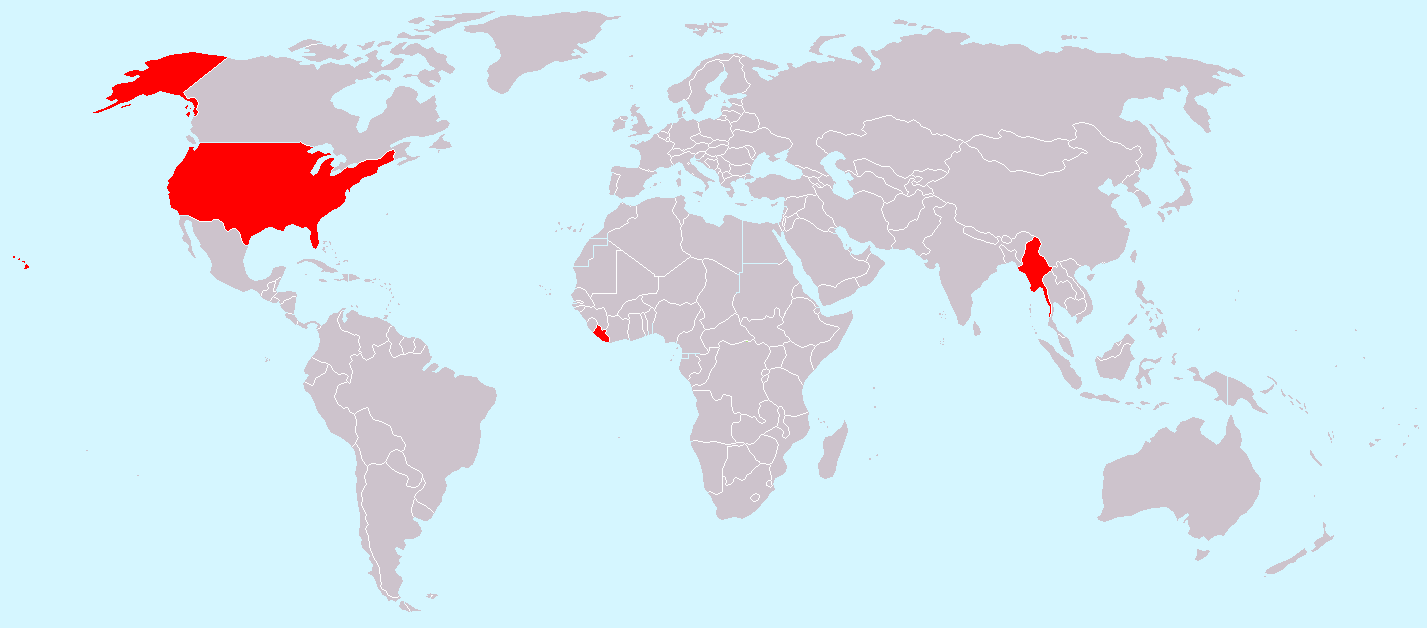
Map of Countries That Don't Use the Metric System

Courtesy of Wikipedia. Click to enlarge.


(Full disclaimer -- there are outliers: miles and pints are used in the UK, carpenters worldwide sometimes use feet and inches, and the medical profession in the US uses metrics.)

01 September 2008

Fun Fact Grab Bag

In Israel:

Everything is negotiable. The advertised price is the most you can expect to pay for something.

Unless that something is gas. Gas is eight bucks a gallon.

Unless you're rolling with quasi-diplomatic status. Overseas hire teachers can obtain embassy gas cards that cut the rate to something like $4 a gallon. But only at certain gas stations. And if the attendant says that your card "doesn't work" and offers to "throw it away for you", take it back immediately and drive to another gas station.

Traffic signals are intense. There's a yellow light AFTER RED and BEFORE GREEN. You are expected to be putting the car in gear and actively getting into the intersection during this interval. To counteract the accidents this must cause, there are two versions of warning lights before the red light: 1) the solid green begins to flash, warning you that the yellow light is coming next. This means "speed up." 2) The actual yellow light. This means you shouldn't be in the intersection, because the cross-traffic is also getting the yellow light (after red) and is getting ready to peel off the line like at the stock car races.

When opening an Israeli bank account, the process takes about an hour and you will sign your name exactly thirty-two times. (According to historical sources, much of this vestigal bureaucratic stuff is due to Israel formerly being under the Ottoman empire, which dearly loved its paperwork.)

When you need a new TV remote, you get it at the post office. I still don't understand this one.

When you have large pieces of garbage, you leave them on the sidewalk outside your house. A truck with a giant robotic arm comes around every so often to pick it up.

The ultra-orthodox shop at Ikea. In their hats and all. Ikea looks exactly the same in every country except for the language in which signs are written. If you contemplate this too much, it begins to break your brain.

Fernet Branca and Drambuie are huge over here and can be found in every bar. I had a Fernet the other night and it gave me a happy Palace Kitchen flashback to 2004.

Paper size is A4, which is longer and narrower than in the US. There is also no such thing as a three-ring binder -- all binders and hole punches have two rings, both very close to the middle of the page.

Nothing is planned by the sea and the sand

My apartment in Nof Yam is located by the sea. If I cross Golda Me'ir street and head west along a dirt road, I eventually come to this:


Photos are photos, but seeing the deep blue waters of the Mediterranean at midday is an experience that is impossible to overbill. The water is warm enough that there's no "shock of recognition" when one steps in. This almost takes the fun out of it. Those from Washington know what I'm talking about. The salt content is extremely high, and there are waves and tides, but on a smaller scale. The tide might change by about 2 or 3 meters at most between lowest and highest.

The cliffs and rocks on the beach are extraordinary in their wear. One is reminded of the face of Clint Eastwood. Click to enlarge:


Through this next rock you can see a black flag. That flag is lifeguard code for unsafe swimming conditions. Red flags mean that it is safe to swim.


One of Israel's striking dualities is the wide, wide gulf between the harried and draining working life in the country and the sheer leisure of being next to the sea and devoting an entire day to reflection and no work whatever.

As I was swimming this evening, I heard my thoughts say: "I could get used to this..." . . . and realized that, yes, one can used to anything, for better or worse. Even breaking the waves in the Med, my mind was worrying about how things would go in middle school band block tomorrow. So, Hasidic wisdom of the day: "Rake the muck this way. Rake the muck that way. It will still be muck. In the time you are brooding, you could be stringing pearls for the delight of heaven."