Berlin Day Two: Wheels, Checkpoints, and the Reichstag by night

We set the alarm early on this second day for a tour appointment near the Alexanderplatz. Alexanderplatz was the main square of East Berlin, and was definitively so for some time. It has an open, stark, utilitarian feel like an abandoned World's Fair site, complete with a huge, unnecessary tower built for the sake of extravagance.

The tower, built by the communist government after the erection of the Berlin wall. Funny anecdote: this tower was built to be a beacon for the symbolic power of the anti-religious communist government, but when the sun shines on the silver polyhedric ball near the top, a very distinct "cross" is formed that can be seen all across Berlin. Berliners quickly and laughingly dubbed this "The Pope's Revenge", to the immense fury of the communists.

It was near Easter, and every shop had their Easter swag out, including Dunkin Donuts. Pretty soon we found our tour people, hopped on our Segways (if you can get over the dorkiness and price it's the best way to go touring) and were off around the city.

Rows and columns of trees on Museum Island.

A church with a neat little domed annex near the center of the city. This was opposite a nearly-identical church, and next to a concert hall.

Cafe Aroma! This was a massive surprise, because this black, white, and red health-themed coffee shop is the Starbucks of Israel, and I didn't know it existed elsewhere. It's weird to see the sign in a Western alphabet. We stopped here for a sandwich and a Coke, and got the lowdown on Checkpoint Charlie, which was up next...

Checkpoint Charlie, as it stands today. There is a replica of the famous "Leaving the American Sector" sign, and a photo of the East Berlin officer you would encounter at the border. Along with Checkpoint Bravo on the south side of the city, this was the only point that both Germans and non-Germans could use to cross into West Berlin, and Charlie was the only one that connected to East Berlin where the Soviets controlled the city.
When East and West Berlin were separated in 1961, it was an overnight separation of two halves of the city. If you happened to be a non-Soviet who was visiting friends in East Berlin that evening, you were stuck. If you were living in East Berlin and had family in West Berlin, you would not be able to see them except under very stringent and weird travelling circumstances, and then they would only be able to visit you through Checkpoint Charlie. Rolls of concertina wire were set up and guards were posted to checkpoints at midnight on August 13th 1961, and the wall was gradually built during the next 14 years. Many of the wealthier and better-educated Germans defected, and East Berlin was left as an impoverished mirror of its Western Half.

I remember when the wall came down, but I never really knew what it meant until I visited the city. Above is a large photograph, posted near the checkpoint, of the scene on 9 November 1989, with East Berliners streaming across the border in a throng of unbelievable force.

And, here is the same street the day I visited, with a picture taken from the same corner. Note the same apothecary sign on the white building, and how the "guard" picture shows an American soldier, since this was taken from the East Berlin side.

Walking around during our Aroma cafe break, we came upon this awesome ball sculpture. Berlin shares the same kind of "enfant terrible" sense of art that Vienna has, and I love these unexpected urban marvels.

I try to roll the sculpture, to little avail.

This is a section of the wall that still stands in a skeletal form, near Checkpoint Charlie in the center of Berlin. West Berliners, hearing of the infrastructural problems communist East Berlin was having, sent over lengths of brand-new sewer pipe as a goodwill gift to beef up the waste-management system. The East Berlin government promptly modified the pipes and mounted them on the top of the wall, making it more difficult to climb over and escape to the West. Times were tough.

One of the few patrol towers still standing in no man's land, or the "death strip". I was surprised to learn that the Berlin Wall was actually two concentric walls, with a militarized gap in the middle for extra security. Eastern guards were assigned two at a time to each shift, so if one tried to defect while on patrol, the other could "stop" them. No two guards were ever on the same shift consecutively -- the idea being that no rapport could develop between them -- and consequently they couldn't make long-term plans to defect together. There are many stories of one guard suddenly running toward the border, and the other having to make a split-second decision to shoot, or to run over with him, as he certainly couldn't report back alone.

The famous Potsdamer Platz, formerly the most lavish and busy square in all of Europe. The Berlin Wall used to cut directly through the middle of this major intersection, and many of these buildings have been built in the last 10 years as reunification has mended the economy and social fabric of Berlin.

This is a weird picture, with a weirder story. The parking lot and apartment complex above is built directly above the remains of the gutted and cement-filled Furherbunker, where Adolf Hitler hid during the final months of WWII and eventually took his own life. It's eerie to realize how centrally in the city this is located -- a mere kilometer or less from the Reichstag. There is only a small makeshift bulletin board and some tacked-on papers to confirm its existence, on the right side of the photo. German law specifically forbids official monuments to Nazism, and it is not listed on any official map, and the site has been developed as though it were any other parcel of land.

Not far away is the Memorial to the Murdered Jews of Europe, which was designed by architect Peter Eisenman and consists of thousands of cement blocks of various heights positioned in a grid. Like the sunken garden I mentioned at the Jewish Museum, this is meant to evoke a sense of unease when walking through, and symbolizes a supposedly ordered system that has lost touch with human reason. It is a unique memorial in that it does not use any symbolism at all. It is much larger than could fit in the picture above.

We then rode by some wonderful modern architecture, which I was so intrigued by that we stopped by again at night, as you'll see shortly. I believe this building across the Spree river was the department of education, using large windows (more on that soon) and simple geometric shapes to create a unique, broad-lined structure. This buildings were only completed in the last few years.

We then rode back, across museum island, to Alexanderplatz, and went back to the hostel for a nap.

Curry 36! Along with Mustafa, this dining phenomenon was on the ground floor of our hostel building, a block south of the entrance. Currywurst is this huge trend in Berlin street food, and it's basically a wurst sausage chopped up and served with special ketchup and curry powder, as well as a side of frites heaped with massive amounts of mayo. This place had a line that was longer and more pervasive that at Mustafa. I waited for 30 minutes for my currywurst, which I enjoyed very much, but not enough for 30 minutes of line.

After napping, it was time for an evening on the town. I wanted to go back to the Spree riverbank with the awesome architecture at night, so we hit up a small museum gallery just up the street on Unter Den Linden. The presentation there was very contemporary, and I don't remember very much from it, but here's a little bit of Pangea to whet your appetite.

When's the second-best time to plant a tree?
Time for dinner. This was a memorable experience. On the way to the art gallery, we spied an opulent, yet casual restaurant called Holyfields. It looked intriguing enough from the street to try a meal there.

Holyfields feels like a high-end hotel, but it's a self-service restaurant. When you enter, you're greeted by a concierge, and you order food and drinks from a huge vertical plasma touchscreen that shows all the different menu options in mouth-watering high definition. Once you order, you're dispensed a futuristic pager (I know, I know) and when it lights up, your order is ready. We sit down and enjoy the ambiance.

The pager goes off, and we go through the cavernous restaurant to pick up our food, which, as I recall, were delicious deconstructed versions of chicken and a sandwich. The pickup windows are named Peter, Paul, and Mary. The traces of biblical symbolism in Holyfields were enough to be creepy and charming at the same time.

After dinner, it's nearly dark, and time to visit the Brandenburg Gate at the end of the boulevard of Unter Den Linden. This was the historic grand entrance to the city of Berlin, and it is grand indeed, as the approach to the city is flanked on either side by the Tiergarten, an enormous bifurcated park that used to be a private hunting preserve. The Brandenburg Gate was also previously part of East Berlin, but just barely, as the wall ran parallel to it directly on the west side. You may recall the famous speeches by Kennedy and Reagan, made from the West Berlin side, but with the gate as the backdrop, and that's how close the border was. At night, special lights go on to illuminate the gate and a few street performers come out. It's a beautiful sight.

Our shadows on the wall of the Reichstag.

And, the Reichstag proper. Headquarters of the German parliament, it was originally opened in 1894, then disused during WWII (Hitler, being not a bit paranoid and superstitious, didn't like it for some reason) and then reconstructed by the architect Norman Foster following German reunification in the 1990s. The most notable aspect of the "new" Reichstag, at least from the outside, is the glass dome on top of the building with a spiral walkway running down. This was originally open to tourists and other spectators who wanted to look in on parliament sessions, but is not largely (and sadly) closed most of the time due to security risks. The rest of the exterior is very much the same as in 1894, but the inside has been gutted, redesigned, and opened up in super-modern fashion.

The new urban planning around the Reichstag is really fun to walk through. Here is a side street directly to the north with plenty of lights that gleam like dentists' mirrors.

More
Bundestag, or modern parliament meeting buildings. Like many of the new government architecture, there are abundant windows that show all the rooms. This is a conscious decision in state architecture to give the
parti pris, or unifying idea, of government transparency. After WWII, the new German government vowed to let the eyes of the public and the light of day vet governmental business, and this is found in the DNA of the new buildings. I loved walking by these beautiful and futuristic structures at night. Here is a brief sampling of the different buildings along the river; notice how much can be seen from the outside in each.


Walking back to the U-Bahn station, we walked by a restaurant where there was a big window into the prep kitchen. Na'ama peers in.

The front-of-house for the same establishment.

Waiting for the U-bahn to come...

Home! I try a new beverage I saw at the corner market because I loved the label. "Wostok" tastes like the forest -- pine tree woodsy with some sour berry flavor -- I kid you not.

A quick walk around the neighborhood before bed. This is another awesome doorway in the "SALVE." courtyard.

And, a wonderful neighborhood bar called the Galander, with a quirky, knowledgeable, and innovative bartender on staff. He invented a cocktail for us with a liquor we were wondering about (St. Germain) and when he wasn't completely satisfied with it, we got it for free and he made another that "worked better". I also tried some Japanese whiskey on the house because he wanted me to try it out. I wish we had gone back another night, but perhaps on another trip. End Day 2.
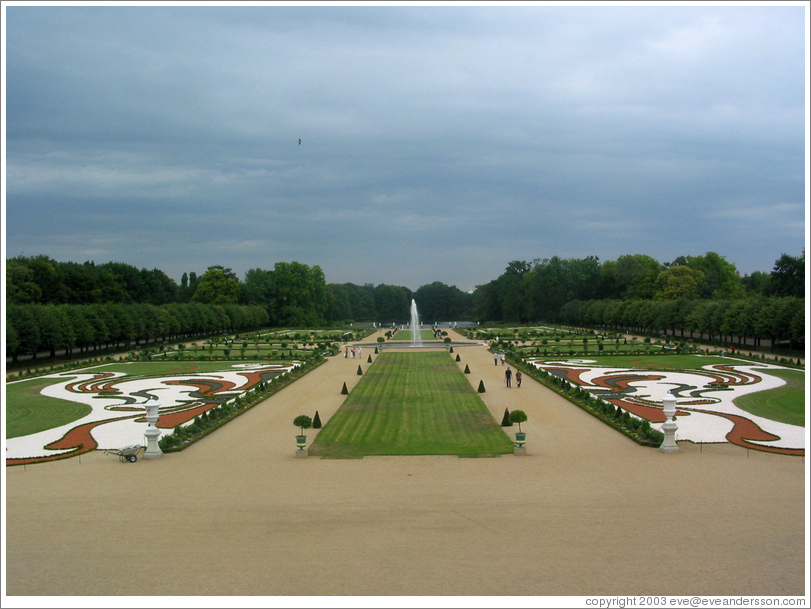
 There comes a time in any Euro city trip where it's time to see the local palace. Today was that day. We took the U-Bahn to Charlottenburg, a brief trip in the Western part of the city, and strolled down the regal boulevard to the palace at the end (barely visible in the above picture.)
 And finally, up close. This palace was commissioned by Sophie Charlotte, the wife of Friedrich III, who was the Elector of Brandenburg, but would soon become Friedrich I, the King of Prussia. It was finally completed and inaugurated in 1699, when Friedrich was 42. This is a statue of him (on his horse, naturally) in the front courtyard.
 These baroque palaces are fun to walk through, and Charlottenburg has one long wing where the rooms connect in sequence from one to the next. Above, you can see the rooms running straight back about six or seven deep, each with a different color and function.
 This room is the Porcelain Cabinet, and it contained Friedrich's beloved collection of porcelain from all over the world, stacked floor to ceiling. Much of it was destroyed in the Second World War (along with much of Charlottenburg Palace) but the palace was restored, and newer imitation china took its place. Still, an impressive room that makes you walk slowly, straight ahead, arms at your sides, with shallow breath.
 The Porcelain Room also had this awesome wind indicator that was hooked up to the roof's weathervane. No wind speed yet at this time in history, but you could see the prevailing winds and probably make some weather predictions.
 In the center of the palace is the chapel, which is smaller than a usual chapel (owing to the size of the estate and the expected numbers of people at services) but no less opulent. Note how the angel frescoes come from above into the main altar area almost seamlessly, and become the three statues. Out of the frame, to the left, there is even a small pipe organ installed in the loft.
 Upstairs there are more guest and servant rooms, and this room that I really wanted to spend more time in. It's an octagonal ballroom, where four of the sides are wall-length windows, and the other four are wall-length mirrors, so the outdoor light is reflected throughout the room no matter where you look. This contributes to the under-lit quality of the photo. There's a huge crystal chandelier with candles, and some more ornate porcelain depicting royal scenes in various corners, and it's a very classy room. A slightly better shot is below, along with a close-up of one of the vases.