14 September 2008

Dr. Shakshuka, cure this hungry man...

There is a magnificent and legendary breakfast dish in Israel called "shakshuka". It is a mixture of spiced tomato base, poached eggs, and whatever else the chef has at hand, served in a hot pan with a side of thick slices of toasted bread for dipping. It looks like this:


By far the most famous emporium for this dish is a place in Tel Aviv called "Dr Shakshuka". I have met Dr. Shakshuka. He looks like a mob lord. His place is very popular, and he has a kind of celebrity chef status in the country as an ambassador of local cuisine. The interior of his reataurant has many kettles:


The Shakshuka was delicious, as advertised. Dr. Shakshuka even sent us some spicy fish chunks on the house, which gave me the heady sensation of being MADE at his restaurant. Here we are passing around some plates at dinner:


And here I am, outside, with an inflated sense of self-satisfaction after consuming the fine doctor's exquisite victuals:


There is a coda to this outing: We went afterward to the most famous (and delicious) ice cream chain in Israel. It is called DR. LEK'S. ("Lek" is Hebrew for "lick".) So, there is a weird thing in Israel with the appellation of "Dr." to things that are excellent, but not necessarily medical, and this pleases me.

06 September 2008

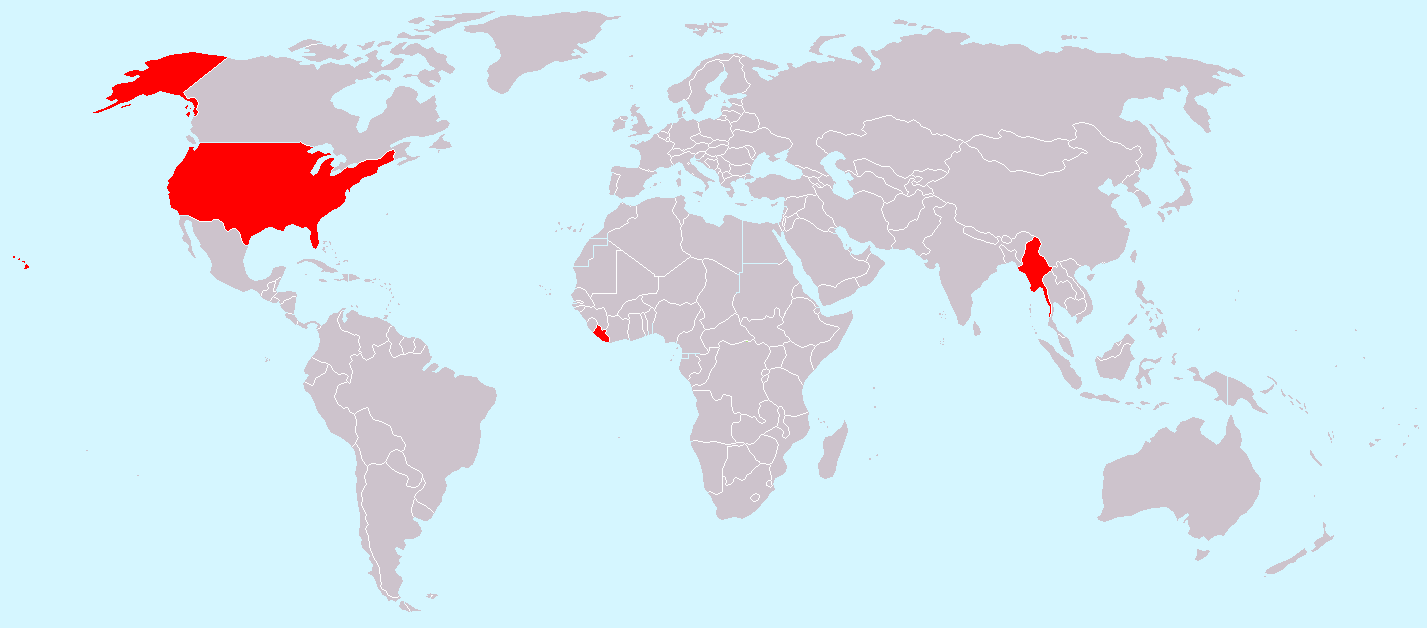
Map of Countries That Don't Use the Metric System

Courtesy of Wikipedia. Click to enlarge.


(Full disclaimer -- there are outliers: miles and pints are used in the UK, carpenters worldwide sometimes use feet and inches, and the medical profession in the US uses metrics.)

01 September 2008

Fun Fact Grab Bag

In Israel:

Everything is negotiable. The advertised price is the most you can expect to pay for something.

Unless that something is gas. Gas is eight bucks a gallon.

Unless you're rolling with quasi-diplomatic status. Overseas hire teachers can obtain embassy gas cards that cut the rate to something like $4 a gallon. But only at certain gas stations. And if the attendant says that your card "doesn't work" and offers to "throw it away for you", take it back immediately and drive to another gas station.

Traffic signals are intense. There's a yellow light AFTER RED and BEFORE GREEN. You are expected to be putting the car in gear and actively getting into the intersection during this interval. To counteract the accidents this must cause, there are two versions of warning lights before the red light: 1) the solid green begins to flash, warning you that the yellow light is coming next. This means "speed up." 2) The actual yellow light. This means you shouldn't be in the intersection, because the cross-traffic is also getting the yellow light (after red) and is getting ready to peel off the line like at the stock car races.

When opening an Israeli bank account, the process takes about an hour and you will sign your name exactly thirty-two times. (According to historical sources, much of this vestigal bureaucratic stuff is due to Israel formerly being under the Ottoman empire, which dearly loved its paperwork.)

When you need a new TV remote, you get it at the post office. I still don't understand this one.

When you have large pieces of garbage, you leave them on the sidewalk outside your house. A truck with a giant robotic arm comes around every so often to pick it up.

The ultra-orthodox shop at Ikea. In their hats and all. Ikea looks exactly the same in every country except for the language in which signs are written. If you contemplate this too much, it begins to break your brain.

Fernet Branca and Drambuie are huge over here and can be found in every bar. I had a Fernet the other night and it gave me a happy Palace Kitchen flashback to 2004.

Paper size is A4, which is longer and narrower than in the US. There is also no such thing as a three-ring binder -- all binders and hole punches have two rings, both very close to the middle of the page.

Nothing is planned by the sea and the sand

My apartment in Nof Yam is located by the sea. If I cross Golda Me'ir street and head west along a dirt road, I eventually come to this:


Photos are photos, but seeing the deep blue waters of the Mediterranean at midday is an experience that is impossible to overbill. The water is warm enough that there's no "shock of recognition" when one steps in. This almost takes the fun out of it. Those from Washington know what I'm talking about. The salt content is extremely high, and there are waves and tides, but on a smaller scale. The tide might change by about 2 or 3 meters at most between lowest and highest.

The cliffs and rocks on the beach are extraordinary in their wear. One is reminded of the face of Clint Eastwood. Click to enlarge:


Through this next rock you can see a black flag. That flag is lifeguard code for unsafe swimming conditions. Red flags mean that it is safe to swim.


One of Israel's striking dualities is the wide, wide gulf between the harried and draining working life in the country and the sheer leisure of being next to the sea and devoting an entire day to reflection and no work whatever.

As I was swimming this evening, I heard my thoughts say: "I could get used to this..." . . . and realized that, yes, one can used to anything, for better or worse. Even breaking the waves in the Med, my mind was worrying about how things would go in middle school band block tomorrow. So, Hasidic wisdom of the day: "Rake the muck this way. Rake the muck that way. It will still be muck. In the time you are brooding, you could be stringing pearls for the delight of heaven."

24 August 2008

Jaffa Port

(sorry for the delay in posting; this last week was the first week of classes.)

As part of our newbie orientation a few weeks ago, we took afternoon expeditions to the sites surrounding Tel Aviv. One of the most fascinating of those sites is the ancient port of Jaffa. The Wikipedia summary is best to get an idea of the thousands of years of the importance of this location. Conquered and re-conquered, named and renamed, since perhaps 7,500 BCE(!)

Here is our gang in front of a fountain of a whale. Your humble narrator is on the right in purple.


The whale is a representation one that swallowed Jonah after he was thrown overboard by his shipmates. Jaffa was the port from which Jonah was to sail to Tarsus.

Here are a few more pictures of the ancient port. Click to enlarge.


New architecture, across the road from the old.

A cool alleyway. Note the coffee shop on the second story.

This shot says a lot about Jaffa: the old hides the necessary new to preserve the feeling of the old.


A majority of the old port buildings have been converted into artist studios. The upper story of this building is an artist loft, I believe.

The gang heads up the steps toward the town square.

It is difficult, and probably outside of the scope of my mind altogether, to comprehend the thousands of years of continuous history in Jaffa and Jerusalem. I see the the well-maintained minarets and walls and cobblestones worn smooth by millions of footsteps, and I'm reminded of how much it resembles "theming" (like at Disney World) where the details of history are painstakingly recreated to transport the visitor. Here, the process is reversed: we're already transported to the place, and the details are a record of all that place has seen.


A stray cat. They are everywhere in Israel, much like squirrels in Washington State.

Apparently you need a license to do this.


View from Tel Jaffa (Jaffa Hill) facing north with the coastline of Tel Aviv and Herzliyya.

A picture of Dan (my roommate) and myself.


And, finally, the port is still a port. Maritime strategy is basically the same after 9,ooo years.


08 August 2008

Groceries

Despite the disclaimer in the first post, I am still surprised by the amount of writing that will revolve around food.

Among the most exhilarating experiences to be had in a country where you can't read the alphabet is shopping for groceries. Familiar food packaging is reassuring (who doesn't like seeing the deconstructed Kellogg's Cornflakes rooster or the montessori-styled JIF jar in the morning?) and when you're in another culture, they have their own cues. An example:

Q: What is in this cup?


A: it is Tahini, which is a staple over here. It's about as big as Ranch dressing is in Kentucky. There is no way to know this information without first buying the cup and testing at home. Then you can memorize the script and find it again at the store.

Q: What is in this package?


A: As advertised, it is cheese. This purveyor was kind enough to put a large and enticing picture on the packaging, and that automatically gives him my business.

(This will be redundant to those who know already, but script in Hebrew is read right to left. This is an extremely weird concept to English readers, and produces the effect of seeing the alphabet from the "other side" as though in a mirror. Try it with the above pictures and you'll see what I mean.)

At orientation this week, we did a lot of sight-seeing, most of which I'll write about in future posts, but I wanted to share a few more grocery experiences. There is a store not far from the school that is called Tiv Taam. It is owned and operated by Russians, and apparently is the only store in the area that "Does Christmas" as we know stores to do in the US in December, and apparently does it so thoroughly as to make up for all the other stores that don't Do Christmas. It looks like this:


Tiv Taam is totally deluxe. It is the Israeli equivalent of Whole Foods or Larry's Market. They have an extensive meats department (with free samples!) and all manner of frozen fish and cereals, but the really noteable feature is their spice selection, and how the spices are displayed. Until our scientists develop Scratch-n-Sniff computer screens, you'll have to use your olfactory imagination on the following photos:


And, for those of you who grew up in the '80s, There is no escape:


Afterward, we went to a small bakery not far from the Tiv Taam. In this bakery, there were whole loaves of bread and pastries with knives and tubs of butter, all of which were to be sampled. It looks like this:


Psychologically, the samples are not free. One feels compelled to buy something after tasting under the eye of the weary baker. I bought a magnificent cheese danish loaf, which afforded me a feeling of entitlement to go on sampling for a few more minutes.


04 August 2008

Morning and the Gatehouse

After I arrived in my Nof Yam apartment from the airport with all my things stacked in boxes, I sat on the couch staring into space, jetlagged out of my mind, and listened to the dripping of the kitchen faucet. It was about 10pm Israeli time. The night was unusually hot and muggy outside, even for Israel in the summer, and the street my building was on had flowers in bloom that produced a sweet pungent smell unlike anything I'd smelled before. These small differences -- temperature and smell and plane fatigue -- produce a kind of emotional loneliness because none of the familiar cues are there. I unpacked every box of my stuff that evening to produce a bit of that familiarity.

Early the next morning, I walked from my apartment to the north to take a look at an old fortress by the sea called Apollonia, directly off the main road. The fortress had been turned into a national park (complete with gatehouse and admission fee) and I walked up the gatehouse to ask the woman for a pass.

Me: "Shabbat Shalom. One, please."
Her: (heavy Israeli accent) "From where are you?"
M: "Excuse me?"
H: "From where are you?"
M: "Oh! Um . . . Seattle. United States."
H: "Seattle! Welcome to Israel! We have a brochure in English around here somewhere . . ." *starts rummaging on desk and pulling binders violently off a wall shelf* "Oh, if I can't find it, it will break my heart ... I really want you to know about this place in English..."
M: "That's alright; I read about it before.."
H: "Oh, but I want you to have it! Why don't you come sit inside? It's hot out there.."

So, I sat inside the booth chatting with this wonderfully friendly Israeli biology student for nearly three hours, eating mango and having a fantastic time while she sold passes to incoming cars. She works at the park one day a month to get some kind of government benefit. Among the things we talked about that I can remember:

- How she's 29, and is getting all kinds of pressure to marry her boyfriend of 12 years, but doesn't want to be "normalized" (that is, in the army for three years, in university for four years, then married and producing babies so her parents will be grandparents. All the people she knows that are normalized are miserable, she said)
-How to meditate on a crowded train to Tel Aviv in the morning
-How medication cured her brother's ADHD, but acupuncture did the same for her
-How movies with unresolved endings are the best, even if they're Iranian

And so on. She was incredibly engaging, and later told me she could get me some passes to live concerts they perform at the fortress at sunset on Fridays "Veeeery Romantic! Bring your friends!" and offered to set me up to meet some musician friends of hers.

I finally told her I had to walk home so I could eat something and take a nap, and she sent me on my way with a plum and an apple.