14 October 2008

On Beyond Budapest


About two weeks ago, the Rosh Hashanah (Jewish New Years') holiday created a five-day weekend from school. These don't come along too often, and a forward-thinking colleague of mine started booking tickets to Hungary for the break.

The single greatest thing about short trips around Europe is the cumulative effect of cheap flights, short flight times, and minimal body-clock changes. It reminds me of the alchemy of taking the subway in New York: a short amount of time turns into an enormous geographic change.

Budapest is a stunning city. Architecturally, historically and culturally rich, and flat enough to walk around all day. The long arterial boulevards with formal architecture remind me very much of Washington, D.C., and the way the sunlight traces its way through the streets makes the city have a different look at all hours.


Walking was the main activity of the trip for me, but some other highlights:
  • The local opera company put on a production of three Stravinsky chamber operas (modern-sounding 20th century stuff), to which I got a rush ticket the evening I arrived. All three were $12 for the most expensive seat in the house, and the productions were astounding -- music, costumes, vitality, you name it -- one of the operas was the famous "L'historie du Soldat" where a travelling soldier meets the devil on the way home from war. All the dialogue was in Hungarian, but the stories mostly made sense (After getting tricked, I think the soldier finally thwarts the devil by rigging a game of cards, but I could be wrong.) During one of the operas, the entire chorus burst out into the audience and began booing and throwing vegetables at the orchestra in one of the many "meta" and convention-destroying moments of the evening. This is something I'll remember forever.
  • Goulash. It's awesome! Paprika is a national treasure in Hungary, and is also used in their delicious house sausage (which was more than reminiscent of Betty's, and made me homesick for the time during family meal.)
  • Late-night beer on the boulevards. Autumn begins to get chilly in Eastern Europe, and one restaurant provided blankets with their outdoor seating:
  • Taking the subway and train to visit a nearby arts town, Szentendre. Didn't buy anything, but took in the fresh air and wonderful churches and meandering streets.
  • A traditional folk dance concert in town with local dancers and musicians. They have dulcimer, violin, and clarinet players the likes of which you've never seen.
There's more, but I'll link two quick-loading Facebook albums here so you can take your own walking tour. It's easy to get caught up in _doing_ things in another country, when a lot of the fun is found in just being there.

Album 1

Album 2

Finally, a picture of me looking rather arch in a restaurant in Jokai square:


And, next time, a story about a desert.

05 October 2008

Security

Israel is almost exactly the size of New Jersey. Over half of that area is the largely uninhabited Negev desert in the southern half of the country, separating Egypt and Jordan.

Israel is also surrounded on at least three sides by sworn enemies who abhor its existence as an independent state. The fourth side is the Mediterranean Sea, which, as of this writing, is a neutral power.

A country in this scenario takes its security very, very seriously.

While I am only just now writing about Israeli security, it is the first thing any traveler will notice, and long before they ever enter the country.

When I flew from Seattle to Atlanta en route to Tel Aviv on September 30th, I went through the usual security checkpoints -- metal detector, shoes off, luggage through the machine. In Atlanta, I needed to change planes.

At the international gate for flights to Israel, everyone and their luggage goes through a second identical security screening before boarding the aircraft. When the aircraft is within one hour of Israeli airspace, the instruction is given by ground control that everyone must remain seated with their seat belt fastened and that there is to be no moving in the cabin whatever. By deduction, this is partly due to the fact that Israel is a very narrow country -- about 8 miles wide in the most densely populated region -- and the ability to land in a neighboring country if something goes awry on the plane is not a viable option.

Once off the plane, I had a letter of introduction from the school, and getting through security was surprisingly easy.

Now, the bizarre part: getting out of Israel is three times harder than getting in.

Some colleagues and I flew to Budapest for the Jewish new years' break (which I will write about later this week). Before obtaining my boarding pass, there was a security checkpoint with a metal detector, X-ray machine, and two security officers around solely for questioning. Some of the questions:

Why are you in Israel?
Do you have friends or family here?
Do you speak any Hebrew?
Where do you work?
Are you coming back?
Why are you traveling for only four days?
Did you pack your own bag?

My answers must have been satisfactory, because I was able to pass through. The teacher I was traveling with had the same destination, visa, and employer, but was taken to the back room for a more thorough search. After getting the boarding pass, there is a secondary checkpoint where your passport and ticket are checked, and you are given a number. My number was 1. I later learned that 1 is the least rigorous security check rating you can be given.

I proceeded to line 1, where I walked through another metal detector and my bags were run through another X-ray. Then a very pleasant security office came over to me and said: "You have four electronic devices in your backpack. Please remove them for me." After I removed and identified my camera, iPod, etc, they were swabbed with the bomb residue detector, as was every internal pocket on each piece of my luggage and the bottoms of my shoes.

All clear, I proceeded to the security checkpoint where they actually stamped passports and asked a few more questions. Then I was clear to get to the gate.

In addition to the above, once in Israel, you will go through a metal detector to enter any mall or movie theater. When driving into any parking garage, you will be asked whether you have a gun and your trunk will be checked. Every large store has an armed guard at the door checking bags. Every field trip I've taken with the school has a medic toting a rifle on each bus. Every man and woman does compulsory military service for at least two years after graduating from high school and one month a year for the majority of their lives thereafter, which means the entire nation can be (and has been) mobilized at a moment's notice by an electronic calling system in the event of a threat.


And I'm not entirely certain of the point of this post, except to illustrate that many of the basic securities we have in the United States cannot be fully understood because they have never been consistently threatened. Also, as oppressive as this situation may sound, it does bring a certain peace of mind to know everyone is on the lookout, and after the first few weeks of sitting on the beach it seems like business as usual.

14 September 2008

Dr. Shakshuka, cure this hungry man...

There is a magnificent and legendary breakfast dish in Israel called "shakshuka". It is a mixture of spiced tomato base, poached eggs, and whatever else the chef has at hand, served in a hot pan with a side of thick slices of toasted bread for dipping. It looks like this:


By far the most famous emporium for this dish is a place in Tel Aviv called "Dr Shakshuka". I have met Dr. Shakshuka. He looks like a mob lord. His place is very popular, and he has a kind of celebrity chef status in the country as an ambassador of local cuisine. The interior of his reataurant has many kettles:


The Shakshuka was delicious, as advertised. Dr. Shakshuka even sent us some spicy fish chunks on the house, which gave me the heady sensation of being MADE at his restaurant. Here we are passing around some plates at dinner:


And here I am, outside, with an inflated sense of self-satisfaction after consuming the fine doctor's exquisite victuals:


There is a coda to this outing: We went afterward to the most famous (and delicious) ice cream chain in Israel. It is called DR. LEK'S. ("Lek" is Hebrew for "lick".) So, there is a weird thing in Israel with the appellation of "Dr." to things that are excellent, but not necessarily medical, and this pleases me.

06 September 2008

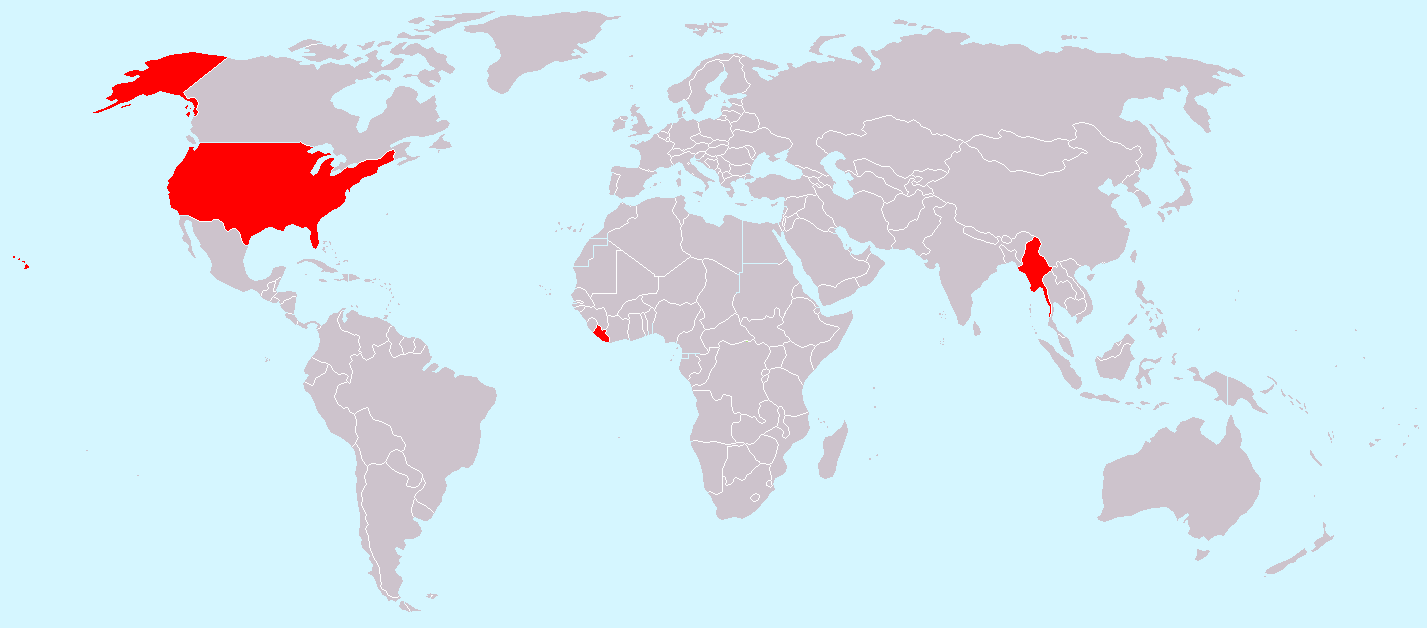
Map of Countries That Don't Use the Metric System

Courtesy of Wikipedia. Click to enlarge.


(Full disclaimer -- there are outliers: miles and pints are used in the UK, carpenters worldwide sometimes use feet and inches, and the medical profession in the US uses metrics.)

01 September 2008

Fun Fact Grab Bag

In Israel:

Everything is negotiable. The advertised price is the most you can expect to pay for something.

Unless that something is gas. Gas is eight bucks a gallon.

Unless you're rolling with quasi-diplomatic status. Overseas hire teachers can obtain embassy gas cards that cut the rate to something like $4 a gallon. But only at certain gas stations. And if the attendant says that your card "doesn't work" and offers to "throw it away for you", take it back immediately and drive to another gas station.

Traffic signals are intense. There's a yellow light AFTER RED and BEFORE GREEN. You are expected to be putting the car in gear and actively getting into the intersection during this interval. To counteract the accidents this must cause, there are two versions of warning lights before the red light: 1) the solid green begins to flash, warning you that the yellow light is coming next. This means "speed up." 2) The actual yellow light. This means you shouldn't be in the intersection, because the cross-traffic is also getting the yellow light (after red) and is getting ready to peel off the line like at the stock car races.

When opening an Israeli bank account, the process takes about an hour and you will sign your name exactly thirty-two times. (According to historical sources, much of this vestigal bureaucratic stuff is due to Israel formerly being under the Ottoman empire, which dearly loved its paperwork.)

When you need a new TV remote, you get it at the post office. I still don't understand this one.

When you have large pieces of garbage, you leave them on the sidewalk outside your house. A truck with a giant robotic arm comes around every so often to pick it up.

The ultra-orthodox shop at Ikea. In their hats and all. Ikea looks exactly the same in every country except for the language in which signs are written. If you contemplate this too much, it begins to break your brain.

Fernet Branca and Drambuie are huge over here and can be found in every bar. I had a Fernet the other night and it gave me a happy Palace Kitchen flashback to 2004.

Paper size is A4, which is longer and narrower than in the US. There is also no such thing as a three-ring binder -- all binders and hole punches have two rings, both very close to the middle of the page.

Nothing is planned by the sea and the sand

My apartment in Nof Yam is located by the sea. If I cross Golda Me'ir street and head west along a dirt road, I eventually come to this:


Photos are photos, but seeing the deep blue waters of the Mediterranean at midday is an experience that is impossible to overbill. The water is warm enough that there's no "shock of recognition" when one steps in. This almost takes the fun out of it. Those from Washington know what I'm talking about. The salt content is extremely high, and there are waves and tides, but on a smaller scale. The tide might change by about 2 or 3 meters at most between lowest and highest.

The cliffs and rocks on the beach are extraordinary in their wear. One is reminded of the face of Clint Eastwood. Click to enlarge:


Through this next rock you can see a black flag. That flag is lifeguard code for unsafe swimming conditions. Red flags mean that it is safe to swim.


One of Israel's striking dualities is the wide, wide gulf between the harried and draining working life in the country and the sheer leisure of being next to the sea and devoting an entire day to reflection and no work whatever.

As I was swimming this evening, I heard my thoughts say: "I could get used to this..." . . . and realized that, yes, one can used to anything, for better or worse. Even breaking the waves in the Med, my mind was worrying about how things would go in middle school band block tomorrow. So, Hasidic wisdom of the day: "Rake the muck this way. Rake the muck that way. It will still be muck. In the time you are brooding, you could be stringing pearls for the delight of heaven."

24 August 2008

Jaffa Port

(sorry for the delay in posting; this last week was the first week of classes.)

As part of our newbie orientation a few weeks ago, we took afternoon expeditions to the sites surrounding Tel Aviv. One of the most fascinating of those sites is the ancient port of Jaffa. The Wikipedia summary is best to get an idea of the thousands of years of the importance of this location. Conquered and re-conquered, named and renamed, since perhaps 7,500 BCE(!)

Here is our gang in front of a fountain of a whale. Your humble narrator is on the right in purple.


The whale is a representation one that swallowed Jonah after he was thrown overboard by his shipmates. Jaffa was the port from which Jonah was to sail to Tarsus.

Here are a few more pictures of the ancient port. Click to enlarge.


New architecture, across the road from the old.

A cool alleyway. Note the coffee shop on the second story.

This shot says a lot about Jaffa: the old hides the necessary new to preserve the feeling of the old.


A majority of the old port buildings have been converted into artist studios. The upper story of this building is an artist loft, I believe.

The gang heads up the steps toward the town square.

It is difficult, and probably outside of the scope of my mind altogether, to comprehend the thousands of years of continuous history in Jaffa and Jerusalem. I see the the well-maintained minarets and walls and cobblestones worn smooth by millions of footsteps, and I'm reminded of how much it resembles "theming" (like at Disney World) where the details of history are painstakingly recreated to transport the visitor. Here, the process is reversed: we're already transported to the place, and the details are a record of all that place has seen.


A stray cat. They are everywhere in Israel, much like squirrels in Washington State.

Apparently you need a license to do this.


View from Tel Jaffa (Jaffa Hill) facing north with the coastline of Tel Aviv and Herzliyya.

A picture of Dan (my roommate) and myself.


And, finally, the port is still a port. Maritime strategy is basically the same after 9,ooo years.